
Spring Kit
Compression Springs: 9/32 X 1/2 in..-- 10 Pieces, 1/4 X 13/32 in..-- 10 Pieces, 7/32 X 11/16 in..-- 10 Pieces, 3/8 X 5/8 in..-- 6 Pieces, 3/8 X 3/4 in..-- 12 Pieces, 7/32 X 1 1/2 in..-- 10 Pieces, 23/64 X 1 3/8 in..-- 8 Pieces, 9/32 X 3/4 in..-- 10 Pieces, Extension Sprin.gs: 13/64 X 13/16 in..-- 10 Pieces,7/32 X 1 in..-- 10 Pieces,1/4 X 7/8 in..-- 10 Pieces, 5/16 X 1 1/8 in..-- 8 Pieces, 5/16 X 7/8 in..-- 10 Pieces, 1 1/32 X 1 27/23 in..-- 12 Pieces, 9/32 X 2 in..-- 12 Pieces, 5/32 X 3 1/8 in..-- 12 Pieces, 3/16 X 1 3/4 in..-- 8 Pieces, 9/32 X 1 1/2 in..-- 10 Pieces, 5/16 X 1 3/4 in..-- 12 Pieces, 11/32 X 1 7/16 in..-- 10 Pieces, case, helical spring
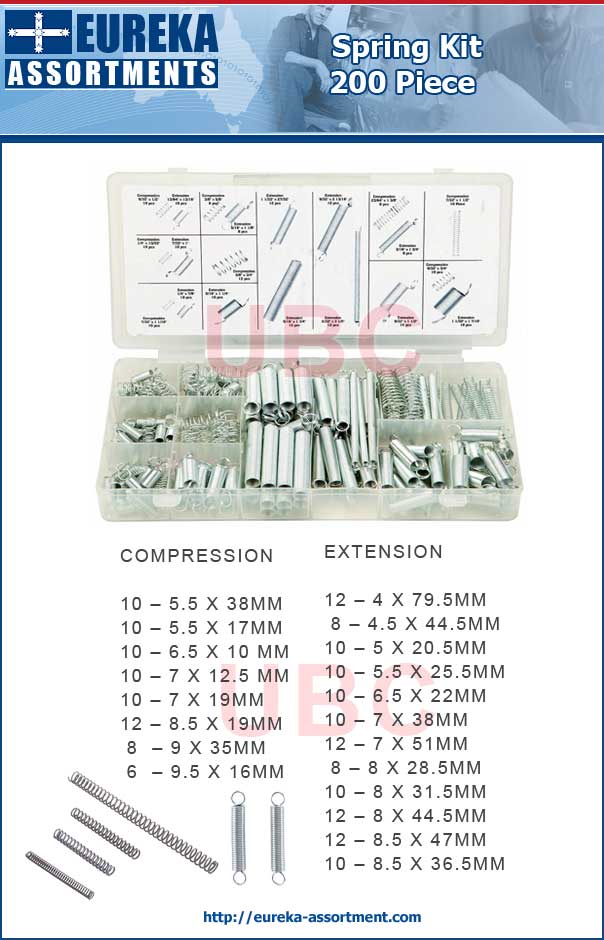
Spring kit 200 piece. A coil spring, also known as a helical spring, is a mechanical device, which is typically used to store energy due to resilience and subsequently release it, to absorb shock, or to maintain a force between contacting surfaces. They are made of an elastic material formed into the shape of a helix which returns to its natural length when unloaded.
One type of coil spring is a torsion spring: the material of the spring acts in torsion when the spring is compressed or extended. The quality of spring is judged from the energy it can absorb. the spring which is capable of absorbing the greatest amount of energy for the given stress is the best one. Metal coil springs are made by winding a wire around a shaped former - a cylinder is used to form cylindrical coil springs.
Variant Types of coil spring are:
Tension-extension coil springs, designed to resist stretching. They usually have a hook or eye form at each end for attachment. Compression coil springs, designed to resist being compressed. A typical use for compression coil springs is in car suspension systems. Torsion springs, designed to resist twisting actions. Often associated to clothes pegs or up-and-over garage doors
Applications, Coil springs have many applications; notable ones include: Buckling springs in computer keyboards, Mattress coils in innerspring mattresses, Upholstery coil springs in upholstery
Extension Springs are attached at both ends to other components. When these components move apart, the spring tries to bring them together again. Extension springs absorb and store energy as well as create a resistance to a pulling force. It is initial tension that determines how tightly together an extension spring is coiled. This initial tension can be manipulated to achieve the load requirements of a particular application. Extension Springs are wound to oppose extension. They are often tightly wound in the no-load position and have hooks, eyes, or other interface geometry at the ends to attach to the components they connect. They are frequently used to provide return force to components that extend in the actuated position.
Applications for extension springs include automotive interiors and exteriors, garage door assemblies, vise-grip pliers, carburetors, trampolines, washing devices, farm machinery, toys as well as thousands of other uses. Extension springs come in a wide array of sizes, from small medical devices to off-road machinery brake springs.
Download catalogue
One type of coil spring is a torsion spring: the material of the spring acts in torsion when the spring is compressed or extended. The quality of spring is judged from the energy it can absorb. the spring which is capable of absorbing the greatest amount of energy for the given stress is the best one. Metal coil springs are made by winding a wire around a shaped former - a cylinder is used to form cylindrical coil springs.
Variant Types of coil spring are:
Tension-extension coil springs, designed to resist stretching. They usually have a hook or eye form at each end for attachment. Compression coil springs, designed to resist being compressed. A typical use for compression coil springs is in car suspension systems. Torsion springs, designed to resist twisting actions. Often associated to clothes pegs or up-and-over garage doors
Applications, Coil springs have many applications; notable ones include: Buckling springs in computer keyboards, Mattress coils in innerspring mattresses, Upholstery coil springs in upholstery
Extension Springs are attached at both ends to other components. When these components move apart, the spring tries to bring them together again. Extension springs absorb and store energy as well as create a resistance to a pulling force. It is initial tension that determines how tightly together an extension spring is coiled. This initial tension can be manipulated to achieve the load requirements of a particular application. Extension Springs are wound to oppose extension. They are often tightly wound in the no-load position and have hooks, eyes, or other interface geometry at the ends to attach to the components they connect. They are frequently used to provide return force to components that extend in the actuated position.
Applications for extension springs include automotive interiors and exteriors, garage door assemblies, vise-grip pliers, carburetors, trampolines, washing devices, farm machinery, toys as well as thousands of other uses. Extension springs come in a wide array of sizes, from small medical devices to off-road machinery brake springs.