
Semi Precision Bearing Kit
semi precision bearing kit 68 piece
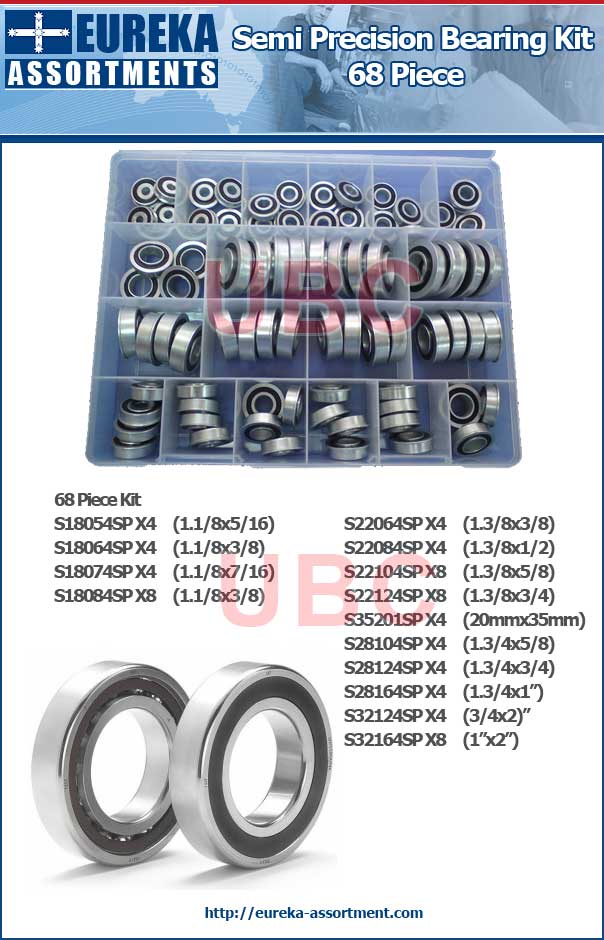
Semi precision bearing kit 68 piece. Precision bearings are designed to deliver the high accuracy, high rotational speed, and high rigidity needed for demanding applications.
Precision bearings are designed to deliver the high accuracy, high rotational speed, and high rigidity needed for demanding applications. Precision bearings are designed to meet the following requirements: Extreme accuracy, High rotational speed, Quiet and smooth running, Minimum friction and heat generation, Controlled rigidity.
From small and large motors to car axles to electric fans and hard disc drives (HDDs), Precision ball bearings are used in a wide array of machines for rotary motion. Precision Ball bearings support rotary parts and reduce friction to facilitate the smooth operation of machines.
Precision Ball bearings are comprised of four major parts: a large ring (outer ring), a small ring (inner ring), balls between the rings (steel balls), and a cage to prevent the balls from hitting each other. The modern structure dates back to around 1500, when Leonardo da Vinci invented ball bearings to reduce friction against the axles of horse drawn carts. For more than 500 years, the ball bearing has been defined by this simple structure.
The Precision of a Ball Bearing, The main function of a ball bearing is to reduce friction and facilitate smooth rotation of an axis. Modern ball bearings test the very limits of precision. As an example, one of the key elements to making an ultra-precise ball bearing is the degree to which the groove where the balls roll can be made into a perfect circle.
The most important performance measure in judging a ball bearing is the extent to which it reduces friction and facilitates smooth and easy rotation. Ball bearings may end up in aircraft, automobiles, precision medical equipment and many other end products, but no matter the application, it is important to maintain smoothness and minimize friction. Changes in the times brings diversification and complexity in end products and machine types along with new performance requirements for ball bearings, including miniaturization, higher rotation speeds, durability and duration, as well as noise reduction.
Download catalogue
Precision bearings are designed to deliver the high accuracy, high rotational speed, and high rigidity needed for demanding applications. Precision bearings are designed to meet the following requirements: Extreme accuracy, High rotational speed, Quiet and smooth running, Minimum friction and heat generation, Controlled rigidity.
From small and large motors to car axles to electric fans and hard disc drives (HDDs), Precision ball bearings are used in a wide array of machines for rotary motion. Precision Ball bearings support rotary parts and reduce friction to facilitate the smooth operation of machines.
Precision Ball bearings are comprised of four major parts: a large ring (outer ring), a small ring (inner ring), balls between the rings (steel balls), and a cage to prevent the balls from hitting each other. The modern structure dates back to around 1500, when Leonardo da Vinci invented ball bearings to reduce friction against the axles of horse drawn carts. For more than 500 years, the ball bearing has been defined by this simple structure.
The Precision of a Ball Bearing, The main function of a ball bearing is to reduce friction and facilitate smooth rotation of an axis. Modern ball bearings test the very limits of precision. As an example, one of the key elements to making an ultra-precise ball bearing is the degree to which the groove where the balls roll can be made into a perfect circle.
The most important performance measure in judging a ball bearing is the extent to which it reduces friction and facilitates smooth and easy rotation. Ball bearings may end up in aircraft, automobiles, precision medical equipment and many other end products, but no matter the application, it is important to maintain smoothness and minimize friction. Changes in the times brings diversification and complexity in end products and machine types along with new performance requirements for ball bearings, including miniaturization, higher rotation speeds, durability and duration, as well as noise reduction.